The Silence Clause: A Barber's Guide to Chair Etiquette
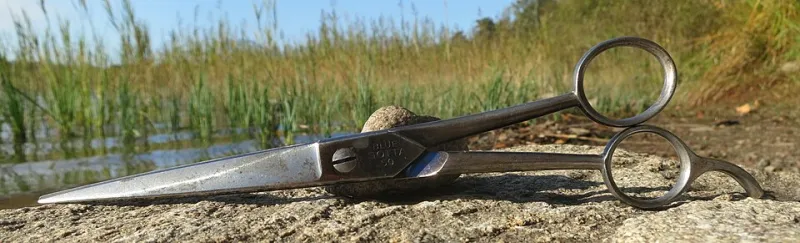
Photo: R. Henrik Nilsson, CC BY 4.0, via Wikimedia Commons
There's a moment in every barbershop, usually around the second minute, when a decision gets made. Not about the haircut — about the conversation. Is this a chat, or is this a quiet one? Get it wrong and you'll spend half an hour nodding at a man with scissors in his hand, or worse, sit in silence while he clearly wanted to hear about your weekend.
After years behind the chair, I can tell you: most haircut disasters aren't technical. They're conversational. So let's decode the whole thing.
The Four-Minute Rule
Every barber has a chat-o-meter. Mine works like this: if a customer sits down and starts talking, we talk. If they sit down and offer nothing but a sigh and their phone, I read that as a green light for silence. Simple.
The trouble starts when the signals get crossed. A bloke who's chatty at first might go quiet mid-cut — that's not a mood swing, that's a man realising he can't check his reflection while his head's being held still. Barbers learn to roll with it. You should too. You're allowed to stop talking. We won't take it personally.
'Just Tidy It Up' Is Not a Brief
Now for the big one. 'Just tidy it up, mate.' I hear it daily, and I'll be honest — it means nothing. Tidy to one man is a centimetre off the ends. Tidy to another is a full reshape. Tidy to a third is 'make me look like the bloke off the telly,' which is a different appointment entirely.
A good barber will interrogate you. How long since your last cut? Do you use product? Any bits you've been quietly hating? Answer those four questions and you'll get a better haircut than any vague instruction ever produced. 'Just tidy it up' said with no further detail is essentially handing someone a pen and saying 'just write something.'
A Field Guide to Barber Phrases
Barbers have a language, and it's more diplomatic than it sounds. Learn the translations:
-
'Shall we take the sides up?' — Your sides need taking up. This is a courtesy. The alternative translation is 'your ears have disappeared and I'm doing you a favour.'
-
'How short are we going on top?' — You said 'short' and I need a number, because short means three different things depending on your generation.
-
'Let's get the back sorted properly' — You've been walking around with a nest and nobody's told you. Today's your lucky day.
-
'I'll just clean up around there' — I'm doing the neckline for free because I can't send you out like that.
-
'Do you want it the same again?' — Please, for the love of all things, say yes or show me a photo. 'Same again' to a barber you've seen once is a gamble.
When to Shut Up (And When to Speak)
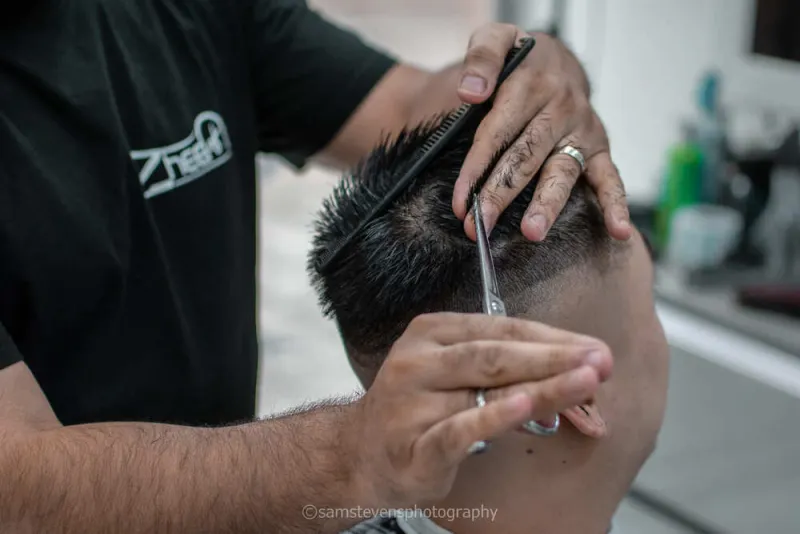
Here's my honest rule: talk all you like while the clippers are out. But when the scissors come round to the fringe, or when the razor's near the neck, stop talking. Moving heads cause uneven lines, and no barber wants to say 'hold still' twice.
Conversely — speak up early. If the guard goes on and your gut says 'that's shorter than I pictured,' say it there and then. Barbers would far rather adjust at minute two than perform a miracle at minute twenty-five. We're not precious. We're holding clippers, not a scalpel.
And the golden one: if you don't like something, tell us before you leave, not in the group chat on the way home. Nine times out of ten it's a two-minute fix. The tenth time, we'll remember for next time — and next time will be better.
The Real Social Contract
Strip it all back and the deal is this: you give us honest words and a still head, we give you a cut you'll be pleased with and, if you're lucky, a decent laugh. You don't need to perform. You don't need to apologise for your hair. You just need to turn up with an opinion — even a small one.
The best chairs I've worked have all had the same energy: relaxed, honest, a bit of banter, zero judgement. That's the standard. Anything less and you're just getting your hair cut. Anything more and you've found your barber.